


Produits de la même famille
Why Purchase from All-Star Telescope?
Free Expert Support
Whether you are a first timer needing help with setting up or an enthusiast that can't quite make that one thing work, our expert staff are ready to support your needs. With decades of knowledge and first hand experience we've been there and we can help you through it!
Stress Free, Secure Transactions
You can trust purchasing and delivery with All-Star Telescope. All of our transactions are 100% secure and Level 1 PCI DSS compliant thanks to Shopify's ShopPay platform. For additional protection, we insure 100% of the value of every shipment we make. If it get's lost during shipment, we replace it. If it gets damaged during shipment, we replace it. We make sure your product arrives exactly as you would expect it to; we promise.
We also ensure privacy protection. We never keep any of your credit card information on file and any of your personal data is stored according to our policies.
30 Day Return Policy
Buy with confidence knowing that we accept returns up to 30 days after purchase. We want you to have something you will actually use and we are confident that we keep good quality products in our store with No Junk.
Price Match Promise
Shipping around for the best price is tough, we make it easier by offering the best pricing in the market. But if you find a better price on an in-store item somewhere else we will match it!
Description du produit
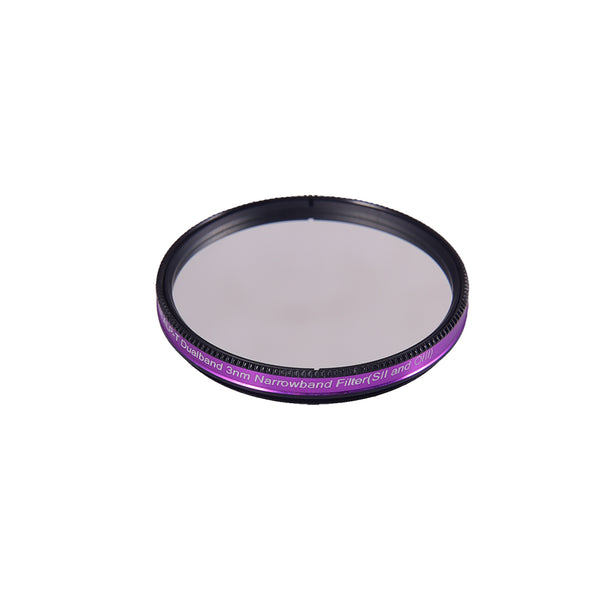
The ALP-T dual band 3nm SII&OIII filter is a dual narrowband filter, which lets the deep red Sulfur-II 672.4nm and the blue-green OIII (500.7nm) lines through and is primarily engineered for color cameras to assist astrophotographers taking deep sky images with superior SNR(Signal to Noise Ratio). With an FWHM half-bandwidth designed at 3nm and achieving an optical density (OD) of 4.5 on unwanted wavelengths, it works strongly in blocking light pollution, moonlight, and airglow, leading to enhanced contrast in nebulae images by effectively passing the SII and OIII emission lines signal only.
It is a significant addition to the popular Antlia ALP-T dual-band Ha&OIII filter and enables false-color images and narrow-band nebula images using OSC. When capturing data with this filter, the nebulae are recorded with high signal-to-noise ratios and greater contrast than without it.
The advanced multi-coatings on Antlia ALP-T dual-band filters effectively isolate the red, Ha line, blue-green, OIII line, deep red SII, and the blue H-beta lines from emission nebulae, with almost total suppression of optical density (OD) 4.5 on unwanted wavelengths from light pollution, moonlight, and airglow. The result is that the ALP-T filters create a superior signal-to-noise ratio and better contrast in your OSC images whether used in urban or rural areas, making them excellent choices for astrophotographers aiming to capture high-quality and more detailed celestial images.
Main Features
- Passes SII 672.4nm and OIII 500.7nm lines
- Capturing of the two main emission wavebands in the deep red and blue-green at the same time
- Ultra FWHM 3nm design allows for increasing exposure time and capturing detailed nebulae signal
- Designed to be used primarily with color cameras to capture cleaner data or used as Luminance filter mono cameras to save imaging time
- Suppression of optical density (OD) 4.5 on unwanted wavelengths improves SNR( signal-to-noise)
- Near IR (NIR) is blocked up to 1100nm
- Ideal flat-top and moderate bandpass reducing spectrum downshifts
- Ion Gun Assisted Deposition of double-sided multi-layer coating technology on the double-sided polished substrate making it the most consistent and accurate light pollution suppression filter
- Halo suppression anti-reflective coating is used to minimize halo and internal reflections
- Designed to suppress artificial lighting from Bortle scale 1 to Bortle scale 8
- Blackened edges of unmounted sizes to minimize internal reflections
- Antlia's ever-trusted coating technology makes filter durability very reliable
Specifications
| Model | Hydrogen Alpha | Oxygen III | Sulfur-II | Hydrogen Beta |
| FWHM | 3nm +0.6/-0.1nm | 3nm +0.6/-0.1nm | 3nm +0.5/-0.5nm | 3.5nm +0.5/-0.5nm |
| CWL (Central Wavelength) | 656.3nm | 500.7nm | 672.4nm | 486.1nm |
| Peak Transmission | 90% | 82% | 90% | 85% |
| Blocking | ≥OD4.5 @ 300-1100nm | ≥OD4.5 @ 300-1100nm | ≥OD4.5 @ 300-1100nm | ≥OD4.5 @ 300-1100nm |
| Filter Thickness | 2mm+/-0.05mm | 2mm+/-0.05mm | 2mm+/-0.05mm | 2mm+/-0.05mm |

Articles, vidéos et liens supplémentaires
Astrophotographie pour les débutants Étape 4 : Prendre des images du ciel profond
Prendre des photos du ciel profond peut être intimidant, heureusement, il existe un processus simple à suivre pour vous permettre d'obtenir de superbes photos ! Voici le processus typique pour pren...
Astrophotographie pour les débutants Étape 3 : Choisir l'équipement pour l'imagerie du ciel profond
L'utilisation d'un capteur d'étoiles vous permet d'acquérir de l'expérience avec les principes fondamentaux de l'imagerie du ciel profond. Tirer sur la Lune vous permet d'acquérir de l'expérience ...
Astrophotographie pour les débutants - Commencer ici : Entrer dans l'astrophotographie étape par étape
Photographier le ciel nocturne n'a jamais été aussi populaire, ni aussi facile. Le choix d'équipement n'a jamais été aussi meilleur, ni plus abordable. Cependant, selon les conseils donnés par Dick...
Astrophotographie pour les débutants Étape 1 : Utilisation du Star Adventurer Tracker
Le moyen de loin le plus économique et le plus simple de capturer de belles images de la Voie lactée et de grands objets du ciel profond comme la galaxie d'Andromède (illustré ici) est d'utiliser u...
Astrophotographie pour les débutants Étape 2 : Comment photographier la Lune
Les gros plans de la Lune sont gratifiants et constituent un moyen facile d'apprendre à photographier à travers votre télescope. Bien que de bons résultats soient possibles avec un appareil photo d...