



Produits de la même famille
Why Purchase from All-Star Telescope?
Free Expert Support
Whether you are a first timer needing help with setting up or an enthusiast that can't quite make that one thing work, our expert staff are ready to support your needs. With decades of knowledge and first hand experience we've been there and we can help you through it!
Stress Free, Secure Transactions
You can trust purchasing and delivery with All-Star Telescope. All of our transactions are 100% secure and Level 1 PCI DSS compliant thanks to Shopify's ShopPay platform. For additional protection, we insure 100% of the value of every shipment we make. If it get's lost during shipment, we replace it. If it gets damaged during shipment, we replace it. We make sure your product arrives exactly as you would expect it to; we promise.
We also ensure privacy protection. We never keep any of your credit card information on file and any of your personal data is stored according to our policies.
30 Day Return Policy
Buy with confidence knowing that we accept returns up to 30 days after purchase. We want you to have something you will actually use and we are confident that we keep good quality products in our store with No Junk.
Price Match Promise
Shipping around for the best price is tough, we make it easier by offering the best pricing in the market. But if you find a better price on an in-store item somewhere else we will match it!
Description du produit
Introducing the ASI676MM, the all-sky camera featuring a unique square 1/1.6-inch image sensor and a super high resolution of 12MP! It is perfectly suited for meteor recording and full sky surveillance. The square format facilitates easier composition, making mosaic stitch simpler and more efficient, and the high resolution brings you clear details of the Sun and our Moon. With this camera, you may start your marvelous journey to explore the boundless night sky.
Why Square Format?
One of the biggest benefits of ASI676MM's square format is it makes the whole mosaic construction process much easier by eliminating the need to consider the difference between the long and wide sides of the format during mosaic stitching.
Not only that, the square format also makes the ASI676MM more compatible with various types of lenses such as fisheye lenses and wide-angle lenses. Thus, ASI676MM is more suitable for tasks such as meteor recording and full sky surveillance.
ASI676MM Features
STARVIS 2
STARVIS is a sensor technology developed by Sony that surpasses the sensitivity of the human eye. STARVIS 2 is an advancement of STARVIS technology, supporting an even higher dynamic range. With this technology, ASI676MM exhibits lower readout noise and dark current, along with significantly enhanced sensitivity in the near-infrared spectrum.
No Amp Glow
ASI676MM does not have any amp glow, no matter how long the exposure and how high the gain value you set. Note: This technology is implemented directly at the hardware level, it does not require software control.
256MB DDR3
The camera is equipped with a USB 3.0 transmission interface and a built-in 256MB DDR3 cache to ensure stable and secure data transmission.
No Amp Glow
ASI676MM does not have any amp glow, no matter how long the exposure and how high the gain value you set. Note: This technology is implemented directly at the hardware level, it does not require software control.
HCG Mode
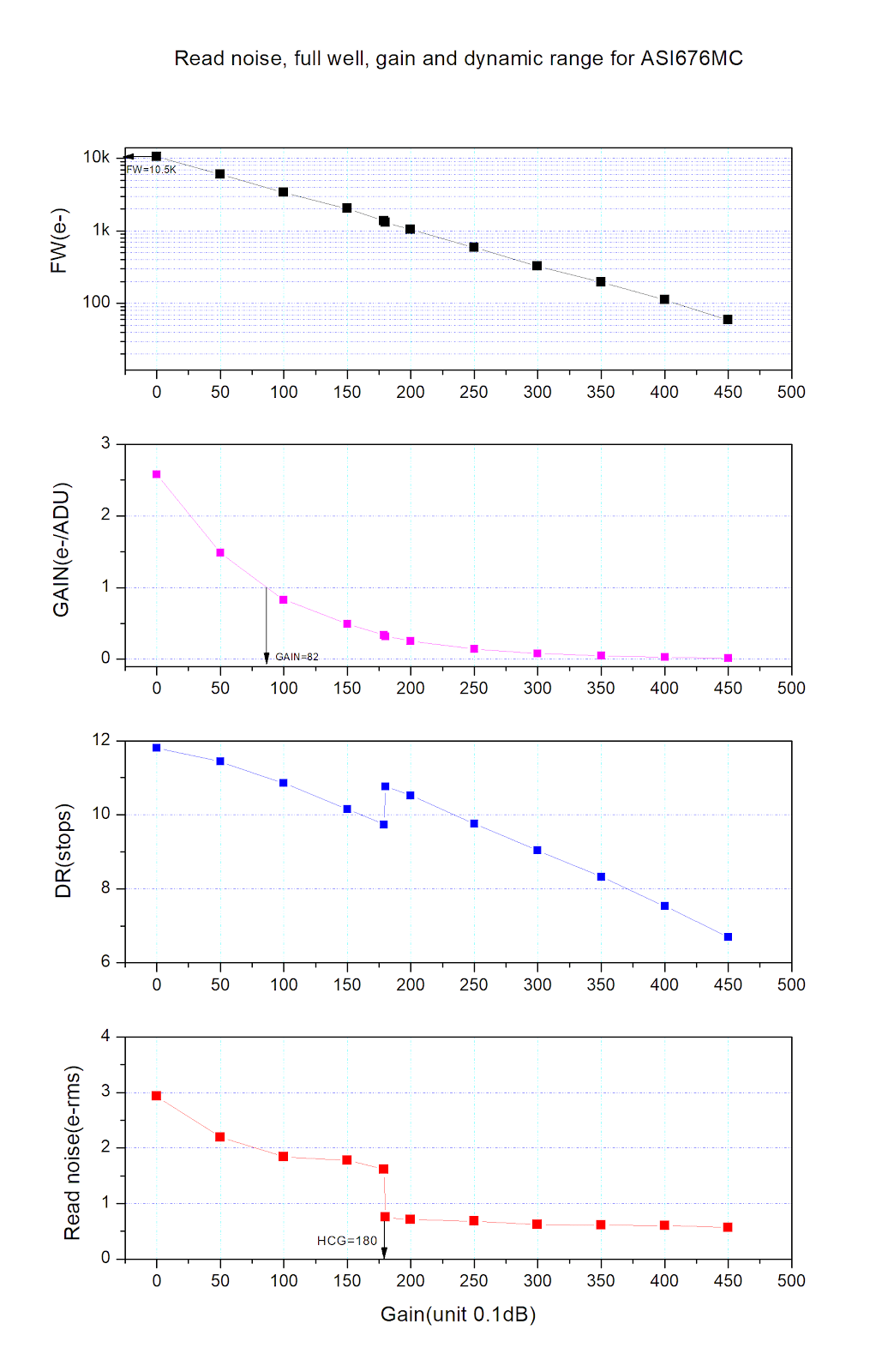
The camera has a built-in HCG mode, which can effectively reduce readout noise at high gain. This allows the camera to maintain the same high dynamic range as it does at low gain. When the gain is 180, the HCG mode is automatically turned on. The readout noise is as low as 0.56e, and the dynamic range can still reach a level close to 11 stops.
Quantum Efficiency
The QE curve and readout noise are very important parameters to measure the camera's performance. Higher OE and lower readout noise are necessary to improve the image signal-to-noise ratio.

Dark Current Noise
The ASI676MM's lower dark current noise means that the image signal-to-noise ratio is also higher, especially when photographing dark objects, it produces images with better sharpness.

UV/IR-cut Coated Window
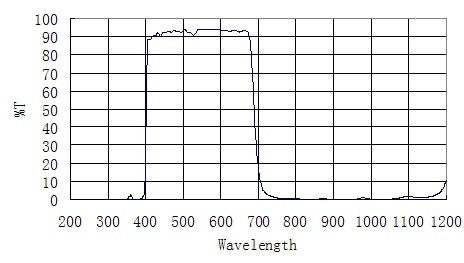
ASI676MM is equipped with an UV/IR-cut coated window in front of the sensor, with a diameter of 21mm and a thickness of 1.1mm. It effectively reduces infrared interference and improves image quality.
Qu'y a-t-il dans la boite
Specifications
| Sensor | Sony 1/1.6" CMOS IMX676 |
| Resolution | 12.61M |
| Image Array | 3552 x 3552 |
| Peak QE | N/A |
| Pixel Size | 2.0um |
| Max Frame Rate at Full Resolution | 31.2 FPS |
| Window | IR-Cut |
| Guide Port | ST4 |
| Shutter | Rolling |
| Exposure Range | 32us - 1000s |
| Read Noise | 0.56e |
| Full Well Capacity | 10.55 Ke |
| Interface | USB3.0/USB2.0 |
| Bit Rate | 12bit output (12 bit ADC) |
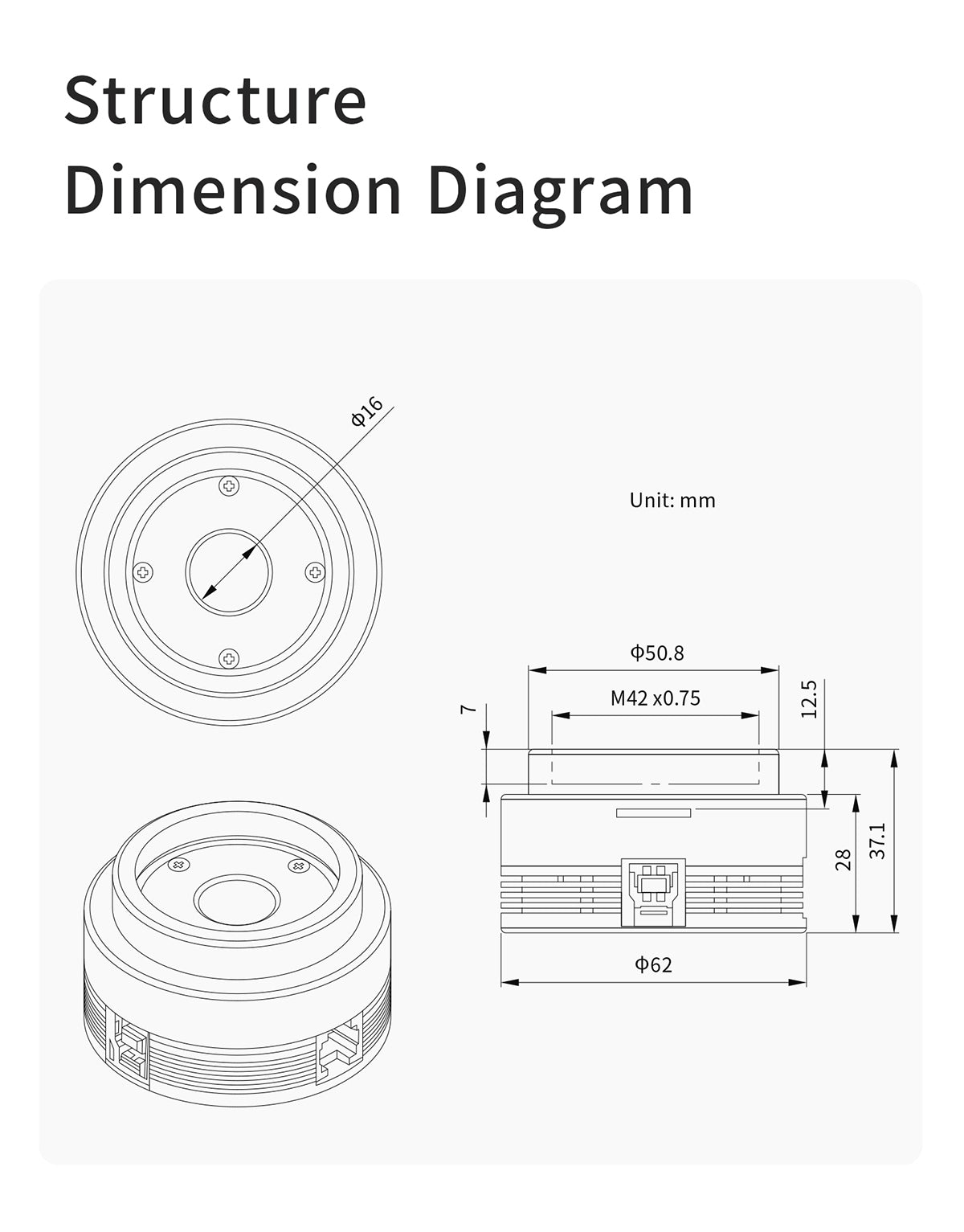
| Dimensions | 62 mm Diameter by 32 mm |
| Weight | 120g (4.2oz) - without lens |
| Working Temperature | -5°C - 45°C |
| Working Relative Humidity | 20% - 80% |
Dimensions
Articles, vidéos et liens supplémentaires
External Links
Astrophotographie pour les débutants Étape 4 : Prendre des images du ciel profond
Prendre des photos du ciel profond peut être intimidant, heureusement, il existe un processus simple à suivre pour vous permettre d'obtenir de superbes photos ! Voici le processus typique pour pren...
Astrophotographie pour les débutants Étape 3 : Choisir l'équipement pour l'imagerie du ciel profond
L'utilisation d'un capteur d'étoiles vous permet d'acquérir de l'expérience avec les principes fondamentaux de l'imagerie du ciel profond. Tirer sur la Lune vous permet d'acquérir de l'expérience ...
Astrophotographie pour les débutants - Commencer ici : Entrer dans l'astrophotographie étape par étape
Photographier le ciel nocturne n'a jamais été aussi populaire, ni aussi facile. Le choix d'équipement n'a jamais été aussi meilleur, ni plus abordable. Cependant, selon les conseils donnés par Dick...
Astrophotographie pour les débutants Étape 1 : Utilisation du Star Adventurer Tracker
Le moyen de loin le plus économique et le plus simple de capturer de belles images de la Voie lactée et de grands objets du ciel profond comme la galaxie d'Andromède (illustré ici) est d'utiliser u...
Astrophotographie pour les débutants Étape 2 : Comment photographier la Lune
Les gros plans de la Lune sont gratifiants et constituent un moyen facile d'apprendre à photographier à travers votre télescope. Bien que de bons résultats soient possibles avec un appareil photo d...